

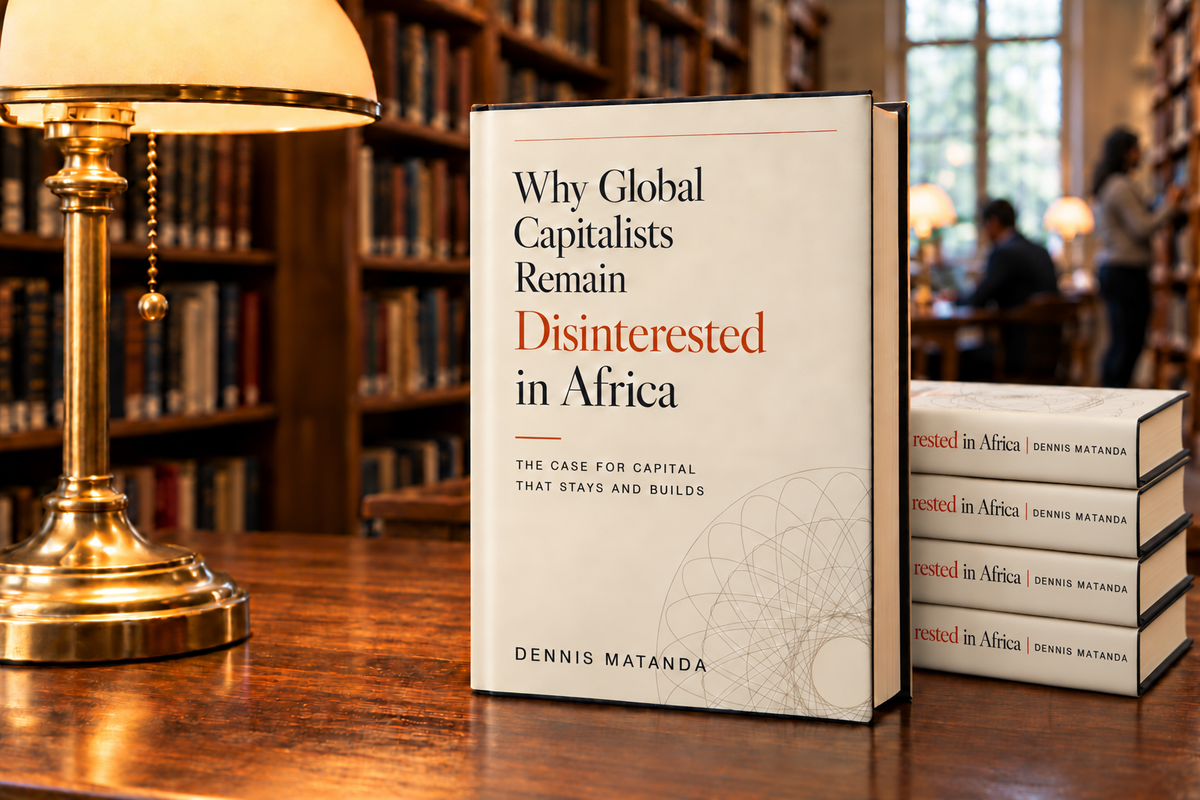
Most of what Africa attracts is disinterested capital: a capital relationship in which the provider can collect the return it seeks without the receiving economy becoming more productive.
In Why Global Capitalists Remain Disinterested in Africa, Dennis Matanda does not complain about the absence of capital. Capital has been coming to Africa for four centuries, and it is still coming. This book asks what it does once it gets there.
The answer is that most of what Africa attracts is disinterested capital: a capital relationship in which the provider can collect the return it seeks without the receiving economy becoming more productive. Someone is paid the return, in some currency. What distinguishes disinterested capital is where it is collected. A remitter is paid in affection. A donor is paid in legitimacy; the government behind the donor, in influence. An insulated investor is paid in money walled off from the surrounding economy: ring-fenced revenues, offshore accounts, external arbitration. Each has saved lives, built houses and run profitable mines. None of them needs Africa to develop before it is sent, granted, lent or renewed next year on the same terms. That is why the continent can go on growing without developing.
The book follows the money through the relationships that carry it: the remittance that cannot say no, the aid that pays its sender, the American corporation that built nations in Asia and prices Africa from a screen, the extractive investment that leaves a hole where a capability should be, and the development finance the author has spent his career inside. It asks each the same two questions. What did this money require of the economy it entered, and what remained once the return had been collected?
It asks nothing of global capitalists out of obligation; they have none. It asks what makes investment in Africa commercially possible and developmentally consequential, why so much of what has come has been the first without being the second, and, where African governments shaped that outcome, it holds them to account.


Comments ()